
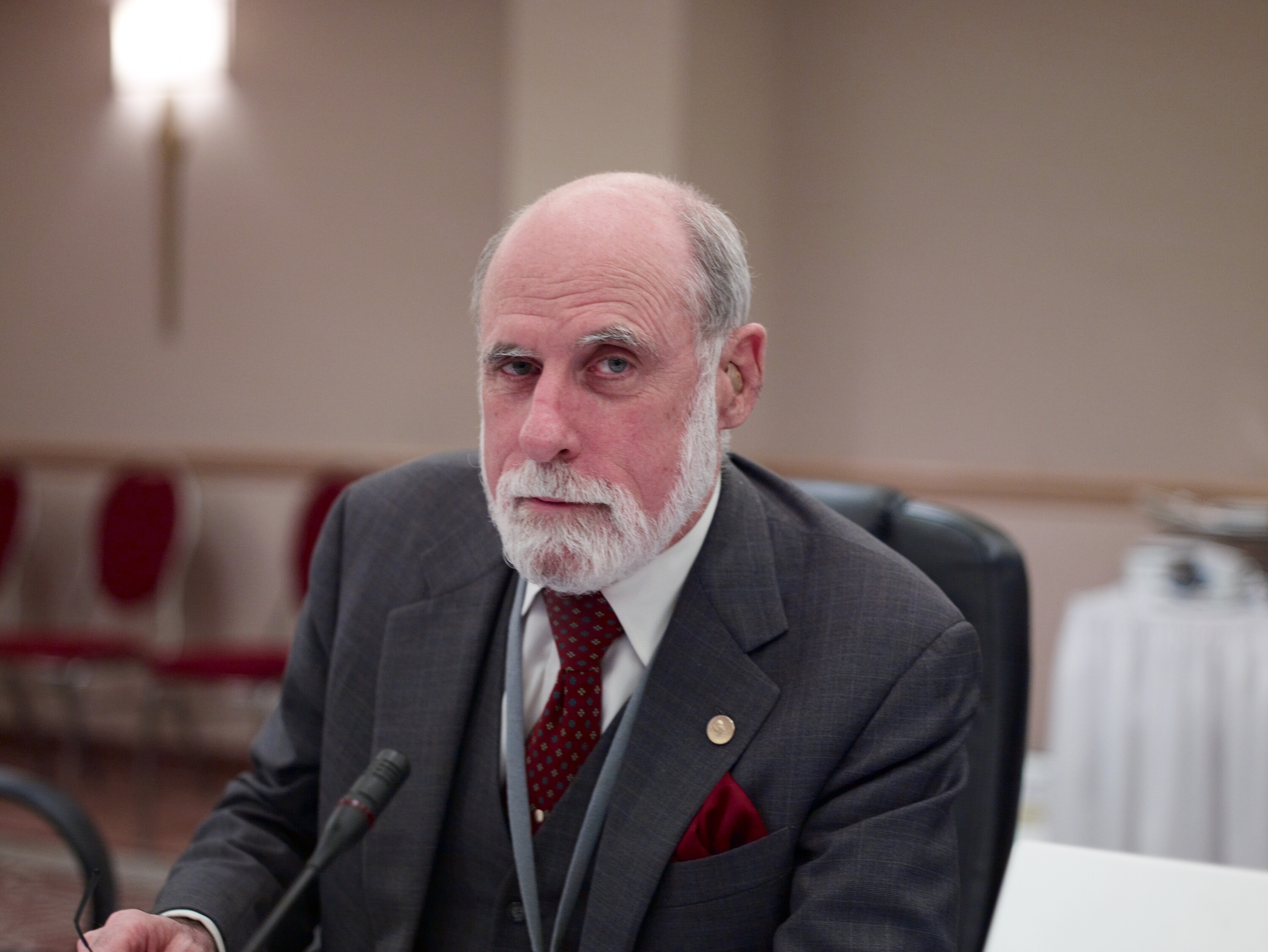
Vint Cerf
Co-designer of TCP/IP and one of the "Fathers of the Internet". Recipient of the Turing Award and Presidential Medal of Freedom.
Contents
Who is Vint Cerf?
Vinton Gray Cerf is one of the two people most directly responsible for the internet existing at all. Together with Bob Kahn, he designed TCP/IP in the early 1970s, the protocol suite that every device on the planet still uses to communicate online. That alone would be enough for a lifetime, but Cerf kept going. He helped build the first commercial email service (MCI Mail), pushed for the creation of ICANN, and spent decades at Google as their “Chief Internet Evangelist,” a title that sounds made up but is very real.
He is often called one of the “Fathers of the Internet,” and unlike most honorary titles, this one is earned. Every packet that moves across the network today follows rules he helped write.
Early Life and Education
Cerf was born on June 23, 1943 in New Haven, Connecticut. He grew up in Los Angeles and showed an early interest in science and mathematics. He attended Stanford University, where he earned a B.S. in Mathematics in 1965. He then went to UCLA for graduate work, earning his Ph.D. in Computer Science in 1972.
At UCLA, he worked in the lab of Leonard Kleinrock, one of the pioneers of packet switching. It was there that Cerf was present for one of the most important moments in computing history: the first ARPANET message sent on October 29, 1969, from UCLA to Stanford Research Institute. The system crashed after transmitting just two letters (“LO” instead of “LOGIN”), but the internet had technically begun.
Creating TCP/IP
The real breakthrough came in 1973-1974. Cerf and Bob Kahn, a DARPA program manager, sat down to solve a fundamental problem: ARPANET worked, but it was just one network. Other networks existed too, each with their own protocols. How do you connect them all?
Their answer was TCP/IP (Transmission Control Protocol / Internet Protocol). The design was elegant in its simplicity:
- IP handles addressing and routing, giving every device a unique number and figuring out how to get packets from A to B
- TCP handles reliability, making sure packets arrive complete and in order, resending anything that gets lost
They published the specification in 1974. On January 1, 1983, ARPANET officially switched to TCP/IP. That date is sometimes called the “birthday of the internet,” and it is hard to argue with it. Every website you visit, every email you send, every video you stream still runs on their protocol.
Career After TCP/IP
After his work at DARPA and Stanford, Cerf moved to MCI Communications in 1982, where he led development of MCI Mail, one of the first commercial email systems. He spent 16 years at MCI, building internet infrastructure before most people knew what the internet was.
In 1992, Cerf co-founded the Internet Society (ISOC), an organization dedicated to keeping the internet open and accessible. He served as chairman of ICANN from 2000 to 2007, overseeing the domain name system during a period of massive growth.
In 2005, Google hired him as Vice President and Chief Internet Evangelist. The role is not ceremonial. Cerf works on internet policy, accessibility, and has been pushing for the development of an interplanetary internet protocol (DTN, Delay-Tolerant Networking) designed to work across the vast distances of space. Because apparently connecting one planet was not enough.
Notable Awards
| Year | Award |
|---|---|
| 1997 | National Medal of Technology (with Bob Kahn) |
| 2004 | ACM Turing Award (with Bob Kahn) |
| 2005 | Presidential Medal of Freedom |
| 2013 | Queen Elizabeth Prize for Engineering |
| 2023 | IEEE Medal of Honor |
The Turing Award is often called the “Nobel Prize of Computing.” Cerf and Kahn are among the very few people whose work genuinely justifies the comparison.
Personal Life
Cerf has been hearing-impaired since birth, which partly motivated his early interest in electronic communication and later his advocacy for internet accessibility. He has consistently pushed for standards that make the internet usable for people with disabilities.
He is known for his formal appearance (he almost always wears a three-piece suit) and his dry sense of humor. When asked about being called a “Father of the Internet,” he once noted that the internet has many fathers, adding: “If it had only one or two fathers, it would not have survived.”
Legacy
The simplest way to understand Cerf's impact: without TCP/IP, there is no internet. Not the web, not email, not streaming, not cloud computing. Every one of those things is built on top of the protocol he co-designed in his early thirties. The fact that a protocol designed in 1974 still works at planetary scale, handling billions of devices and exabytes of traffic, speaks to how well they got it right the first time.
References
- Vint Cerf, Wikipedia
- A Protocol for Packet Network Intercommunication (Cerf & Kahn, 1974)
- Internet Hall of Fame, Vint Cerf
- ACM Turing Award Citation, 2004
Sources
Information compiled from Wikipedia, Internet Hall of Fame, ACM, Google corporate biography, and historical networking resources up to 2026.