
Tim Berners-Lee
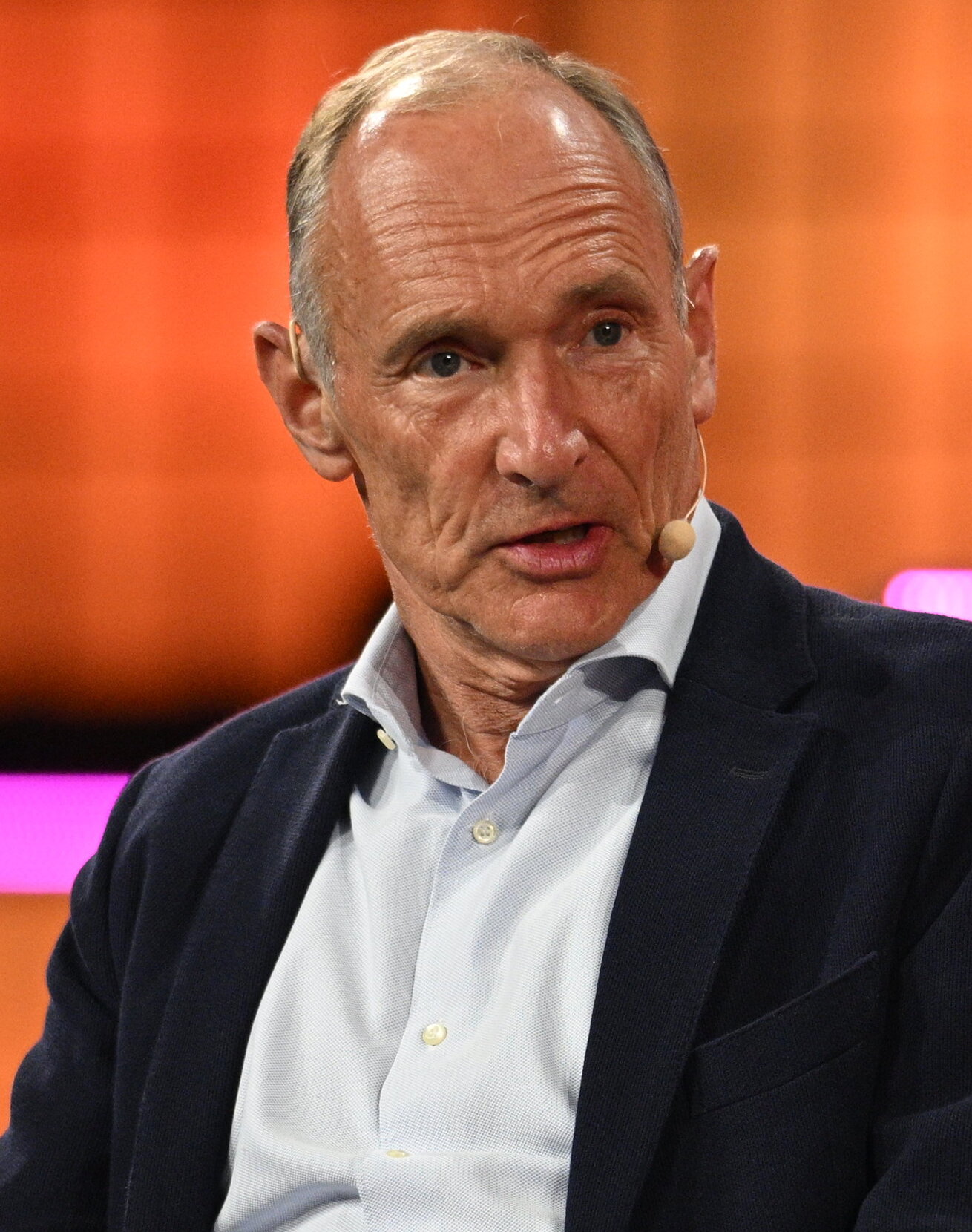
British computer scientist who invented the World Wide Web in 1989 at CERN. He gave it to the world for free.
Contents
Who is Tim Berners-Lee?
Sir Timothy John Berners-Lee is the person who invented the World Wide Web. Not the internet (that existed before him), but the web: the system of hyperlinked pages, URLs, HTML, and HTTP that turned the internet from a tool for academics and military researchers into something your grandmother uses to watch cooking videos. He built the first web browser, the first web server, and the first website. He did all of this in 1989-1990 while working at CERN in Switzerland, and then he gave it away for free.
That last part is worth repeating. He could have patented it. He could have licensed it. Instead, he insisted that the web remain open and free for everyone. It is not an exaggeration to say this single decision shaped the modern world more than almost any other in technology.
Early Life and Education
Berners-Lee was born on June 8, 1955, in London, England. Both his parents were computer scientists who worked on the Ferranti Mark 1, one of the first commercial computers. So technology was quite literally in his blood.
He studied physics at The Queen's College, Oxford, graduating in 1976. During his time at Oxford, he built his first computer from an old television set, a Motorola processor, and a soldering iron. After graduation he worked at various telecommunications and software companies before landing a contract position at CERN in 1980.
Inventing the World Wide Web
In 1980, during his first stint at CERN, Berners-Lee wrote a program called ENQUIRE. It was a simple hypertext system for organizing information, essentially a personal wiki before wikis existed. He left CERN, came back in 1984, and kept thinking about the problem: thousands of researchers at CERN were generating massive amounts of data, and there was no good way to share or link it together.
In March 1989, he submitted a proposal titled “Information Management: A Proposal.” His boss wrote “Vague but exciting” on the cover page. That might be the greatest understatement in the history of technology.
By the end of 1990, Berners-Lee had built:
- HTML (HyperText Markup Language), the language for creating web pages
- HTTP (HyperText Transfer Protocol), the rules for transferring them
- URLs (Uniform Resource Locators), the addressing system
- The first web browser (called WorldWideWeb, later renamed Nexus)
- The first web server (running on his NeXT computer at CERN)
- The first website (info.cern.ch), which went live on December 20, 1990
The first website was, fittingly, a page explaining what the World Wide Web was.
Making the Web Free
In 1993, CERN made a decision that changed history: they released the World Wide Web software into the public domain. Berners-Lee had been pushing for this from the beginning. He understood that a proprietary web would never reach its potential.
The timing was perfect. Mosaic, the first popular graphical browser, launched the same year. Within two years, the web exploded from a few hundred sites to tens of thousands. By the end of the 1990s, it had fundamentally transformed commerce, communication, and culture.
W3C and Later Work
In 1994, Berners-Lee founded the World Wide Web Consortium (W3C) at MIT. The organization develops and maintains web standards, the rules that keep the web interoperable. Every time your browser correctly displays a website built by someone on the other side of the planet, that is W3C standards at work.
He directed W3C for nearly 30 years, stepping down in 2022. During that time he championed:
- Web accessibility for people with disabilities
- The Semantic Web (making web data machine-readable)
- Net neutrality and digital privacy
- Solid, a project to give users control over their personal data
In recent years, he has become an outspoken critic of how the web has evolved. He has spoken against mass surveillance, the concentration of power in a few platforms, and the spread of misinformation. “The web was designed to be decentralized,” he has said repeatedly, and he is not happy about the centralization that has occurred.
Notable Awards
| Year | Award |
|---|---|
| 2004 | Knighted by Queen Elizabeth II (KBE) |
| 2004 | First Millennium Technology Prize (1 million euros) |
| 2013 | Queen Elizabeth Prize for Engineering |
| 2016 | ACM Turing Award |
| 2017 | Named to the Order of Merit (one of 24 living members) |
Legacy
There is a straightforward test for impact: imagine the world without their contribution. Without Tim Berners-Lee, there is no web. There are no websites, no browsers, no URLs. The internet would still exist, but it would look nothing like what we use today. Email would work. File transfers would work. But the connected, hyperlinked, instantly accessible layer that sits on top of it all? That was his idea, his code, and his choice to give it to the world.
References
- Tim Berners-Lee, Wikipedia
- “Information Management: A Proposal” (CERN, March 1989)
- Weaving the Web (Tim Berners-Lee, 1999)
- W3C History Archives
Sources
Information compiled from Wikipedia, W3C, CERN archives, the Computer History Museum, and biographical resources up to 2026.